

India leads the world in what’s called “popular adoption of crypto,” according to a report released Tuesday by Chainalysis — metrics that go beyond raw transaction volumes.
Although this global adoption is down significantly from historic highs, the data suggests resilience in the Central and South Asia and Oceania (CSWA) region and lower-middle-income countries.
Chainalysis’s Global Cryptocurrency Adoption Index seeks to identify countries where most people invest the largest share of their wealth in cryptocurrencies.
The company analyzes data from 154 countries across five sub-indexes. These include on-chain crypto value and retail value received on centralized exchanges and DeFi protocols, as well as peer-to-peer trading volume.
It then weights the rankings based on population size and purchasing power and takes the geometric mean of each country’s ranking in the five areas.
Adoption in India despite the tax regime
Chainalysis’s Global Crypto Adoption Index places India at the top, as it ranks among the top five in categories such as the use – in terms of estimated transaction volume – of centralized and decentralized exchanges, as well as token lending protocols and smart contracts.
The country has also become the second-largest crypto market in the world by estimated gross trading volume, beating several wealthier countries, according to the report.
This ranking comes despite India opting to impose high capital gains taxes on crypto profits earlier this year. Higher than most countries, the 30% tax on crypto gains is higher than its tax rate on other investments, such as stocks.
More recently, the governor of the country’s central bank compared to speculative gambling activities. But Indian Prime Minister Narendra Modi called for an international framework to govern cryptocurrencies at the B20 summit last month. He noted that “not only cryptography, but all emerging technologies need a global framework and regulations.”
Besides India, Chainalysis identified five other countries from the SWAC region in the top 10: Vietnam, Philippines, Indonesia, Pakistan and Thailand.
In the Philippines – captured by NFT-based video game Axie Infinity – around 20% of its crypto-related web traffic is directed to gaming and betting platforms. Pakistan and Vietnam see a greater share of activity on peer-to-peer exchanges.
DeFi has become more prevalent in the region over the past year, accounting for approximately 56% of trading volume between July 2022 and June 2023, up from 35.2% in the previous 12 months. Nearly 70% of this volume came from transfers valued at $1 million or more – up from 58% the year before – indicating greater institutional adoption.
Lower-middle-income countries show stronger adoption recovery
The ranking comes as crypto market volumes have declined significantly in recent times.
Although the prices of bitcoin (BTC) and ether (ETH) have increased year-to-date, they are down approximately 64% and 68%, respectively, from their all-time highs in November 2021.
“While there has been a marked recovery since the doldrums of late 2022, around the time FTX imploded, popular adoption is still well below its all-time highs,” the report states.
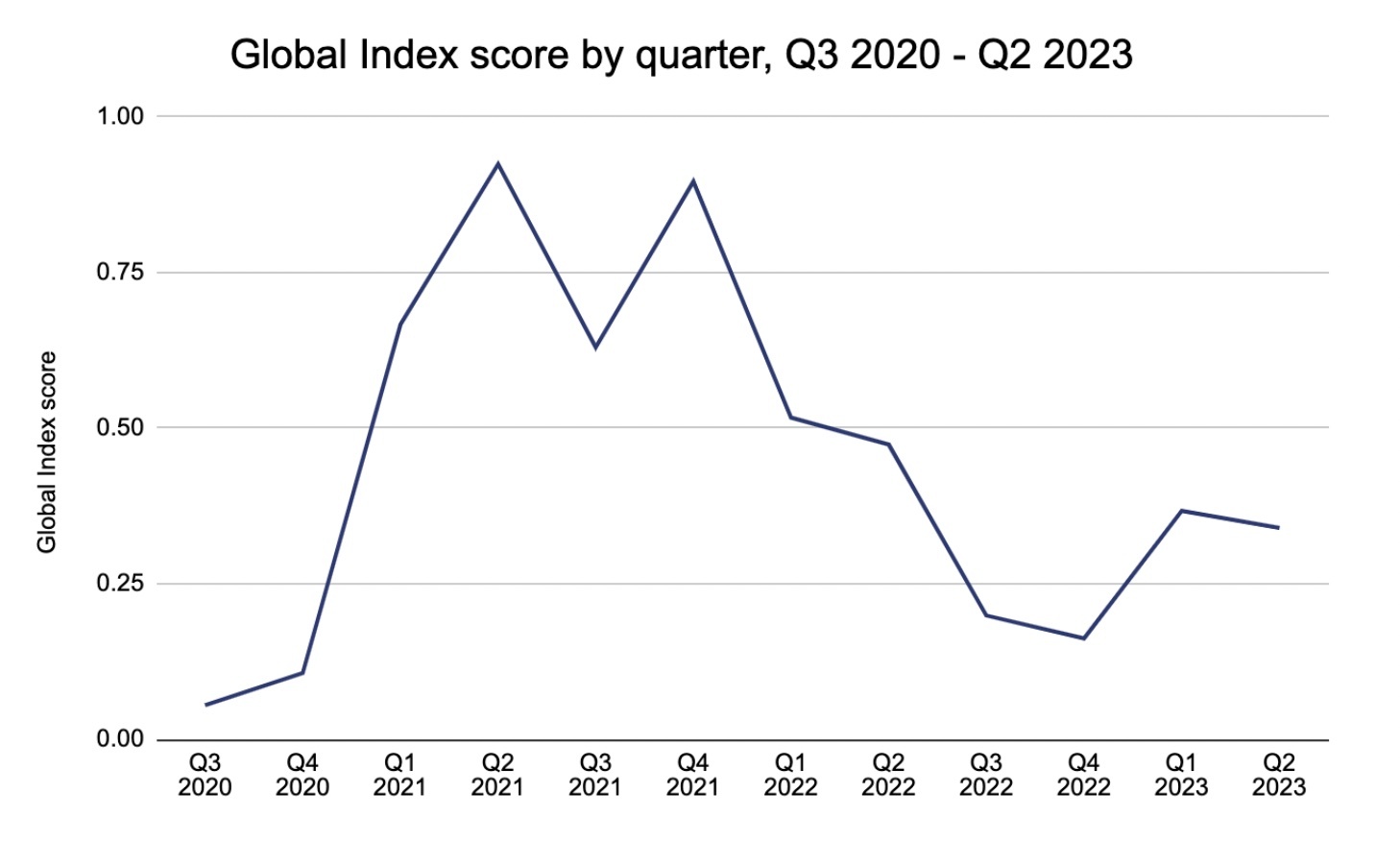
But lower middle income (LMI) countries — a classification defined by the New World Bank – is the only category in which total grassroots adoption is higher than in Q3 2020.
About 40% of the world’s population lives in lower-middle-income countries, including countries such as India, Nigeria and Ukraine. These are often countries with growing industries and populations, the report notes.
“If LMI countries are the future, then the data indicates that crypto will play an important role in that future,” adds Chainalysis. “This, combined with the fact that institutional adoption – primarily driven by organizations in high-income countries – continues to gain momentum even during the current crypto winter, paints a promising picture of the future.”
Get news delivered to your inbox. Explore Blockworks newsletters:


